Does Hitting a 10 Chance Again Raise Your Chances
What Are the Chances?
A probabilistic science projection from Scientific discipline Buddies
Central Concepts
Mathematics
Probability
Fractions
Percentages
Introduction
Have you ever heard anyone say the chance of something happening is "50–50"? What does that actually mean? This phrase has something to practise with probability. Probability tells you how likely it is that an event will occur. This means that for certain events you lot can actually summate how probable it is that they will happen. In this activity, you volition do these calculations and and so test them to come across whether they hold true for reality!
Background
Probability allows the states to quantify the likelihood an event will occur. You might be familiar with words nosotros use to talk about probability, such every bit "certain," "likely," "unlikely," "impossible," and so on. Yous probably also know that the probability of an event happening spans from impossible, which means that this issue will not happen nether any circumstance, to certainty, which ways that an consequence will happen without a doubt. In mathematics, these extreme probabilities are expressed every bit 0 (impossible) and 1 (certain). This ways a probability number is always a number from 0 to i. Probability can too exist written as a percent, which is a number from 0 to 100 percentage. The higher the probability number or percentage of an result, the more probable is it that the event will occur.
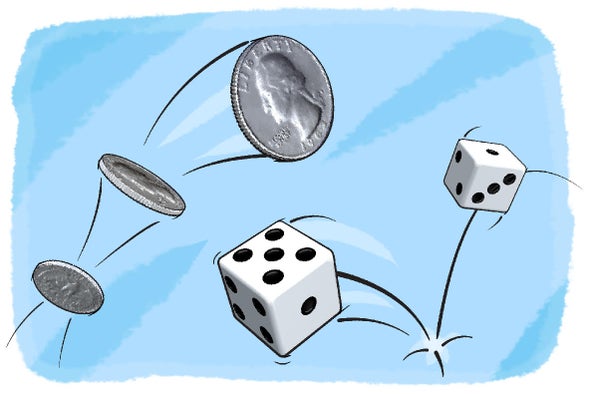
The probability of a sure event occurring depends on how many possible outcomes the effect has. If an upshot has merely one possible effect, the probability for this event is always i (or 100 percentage). If there is more than i possible outcome, however, this changes. A elementary instance is the coin toss. If you toss a coin, there are ii possible outcomes (heads or tails). As long as the coin was non manipulated, the theoretical probabilities of both outcomes are the same–they are equally probable. The sum of all possible outcomes is e'er 1 (or 100 per centum) because information technology is sure that one of the possible outcomes will happen. This means that for the coin toss, the theoretical probability of either heads or tails is 0.five (or fifty percentage).
It gets more complicated with a six-sided die. In this case if you lot roll the die, there are 6 possible outcomes (1, 2, 3, 4, five or half-dozen). Can you lot effigy out what the theoretical probability for each number is? It is 1/half dozen or 0.17 (or 17 percent). In this activity, you will put your probability calculations to the test. The interesting role nearly probabilities is that knowing the theoretical likelihood of a certain outcome doesn't necessarily tell yous anything almost the experimental probabilities when yous actually try it out (except when the probability is 0 or ane). For example, outcomes with very low theoretical probabilities do actually occur in reality, although they are very unlikely. Then how do your theoretical probabilities match your experimental results? You will find out by tossing a coin and rolling a die in this activity.
Materials
- Coin
- Half-dozen-sided dice
- Newspaper
- Pen or pencil
Preparation
- Set up a tally sheet to count how many times the coin has landed on heads or tails.
- Prepare a second tally sheet to count how often you lot take rolled each number with the die.
Procedure
- Calculate the theoretical probability for a coin to land on heads or tails, respectively. Write the probabilities in fraction class. What is the theoretical probability for each side?
- Now get ready to toss your money. Out of the 10 tosses, how often exercise you expect to get heads or tails?
- Toss the coin 10 times. Subsequently each toss, record if you got heads or tails in your tally sheet.
- Count how oftentimes you got heads and how often you lot got tails. Write your results in fraction class. For instance, iii tails out of 10 tosses would be three/10 or 0.3. (The denominator will always be the number of times you toss the coin, and the numerator volition exist the upshot you lot are measuring, such equally the number of times the coin lands on tails.) Yous could also express the same results looking at heads landings for the aforementioned 10 tosses. And so that would exist 7 heads out of 10 tosses: 7/10 or 0.seven. Do your results friction match your expectations?
- Practice another 10 coin tosses. Exercise you expect the same results? Why or why not?
- Compare your results from the 2nd circular with the ones from the first round. Are they the same? Why or why not?
- Continue tossing the coin. This time toss information technology thirty times in a row. Record your results for each toss in your tally sheet. What results do you expect this time?
- Look at your results from the xxx money tosses and convert them into fraction course. How are they unlike from your previous results for the 10 coin tosses?
- Count how many heads and tails you got for your total money tosses and so far, which should be fifty. Again, write your results in fraction form (with the number of tosses as the denominator (l) and the result yous are tallying as the numerator). Does your experimental probability match your theoretical probability from the kickoff stride? (An easy manner to convert this fraction into a percentage is to multiply the denominator and the numerator each by 2, so 50 ten 2 = 100. And after you multiply your numerator by ii, you will have a number that is out of 100—and a percentage.)
- Calculate the theoretical probability for rolling each number on a vi-sided die. Write the probabilities in fraction course. What is the theoretical probability for each number?
- Take the die and roll it 10 times. After each roll, record which number you got in your tally sheet. Out of the 10 rolls, how often do yous expect to go each number?
- After 10 rolls, compare your results (written in fraction form) with your predictions. How shut are they?
- Practise another 10 rolls with the die, recording the result of each curlicue. Do your results modify?
- Now roll the dice xxx times in a row (recording the result after each roll). How oft did y'all roll each number this fourth dimension?
- Count how frequently you lot rolled each number in all combined 50 rolls. Write your results in fraction class. Does your experimental probability friction match your theoretical probability? (Use the same formula you used for the coin toss, multiplying the denominator and the numerator each by ii to go the percentage.)
- Compare your calculated probability numbers with your actual data for both activities (money and dice). What do your combined results tell yous nigh probability?
- Extra: Increase the number of coin tosses and dice rolls even further. How do your results compare with the calculated probabilities with increasing number of events (tosses or rolls)?
- Actress: Expect up how probabilities can exist represented by probability copse. Can y'all depict a probability tree for the money toss and die roll?
- Extra: If you are interested in more advanced probability calculations, discover out how you can summate the probability of a recurring event, for instance: How likely it is that you lot would get two heads in a row when tossing a coin?
Observations and Results
Computing the probabilities for tossing a coin is fairly straightforward. A coin toss has only two possible outcomes: heads or tails. Both outcomes are equally likely. This ways that the theoretical probability to become either heads or tails is 0.5 (or 50 percent). The probabilities of all possible outcomes should add up to 1 (or 100 percent), which it does. When you tossed the coin 10 times, yet, you about likely did not go 5 heads and five tails. In reality, your results might accept been iv heads and six tails (or another non-5-and-v effect). These numbers would be your experimental probabilities. In this case, they are 4 out of 10 (0.iv) for heads and 6 out of 10 (0.6) for tails. When you repeated the ten coin tosses, yous probably ended up with a unlike result in the 2nd round. The same was probably truthful for the 30 money tosses. Even when you lot added up all 50 coin tosses, you lot most likely did not end up in a perfectly fifty-fifty probability for heads and tails. Your experimental probabilities thus probably didn't lucifer your calculated (theoretical) probabilities.
You likely observed a similar phenomenon when rolling the die. Although the theoretical probability for each number is 1 out of 6 (1/6 or 0.17), in reality your experimental probabilities probably looked different. Instead of rolling each number 17 percentage out of your full rolls, you might accept rolled them more or less often.
If you connected tossing the coin or rolling the dice, you probably have observed that the more than trials (money tosses or dice rolls) y'all did, the closer the experimental probability was to the theoretical probability. Overall these results mean that even if you lot know the theoretical probabilities for each possible event, you can never know what the actual experimental probabilities volition exist if there is more one outcome for an event. Afterwards all, a theoretical probability is only predicting how the chances are that an consequence or a specific outcome occurs—it won't tell you what will really happen!
More to Explore
Probability, from Math Is Fun
Probability Tree Diagrams, from Math Is Fun
Frequency of Outcomes in a Minor Number of Trials, from Science Buddies
Pick a Card, Any Card, from Scientific discipline Buddies
STEM Activities for Kids, from Science Buddies
This activity brought to you lot in partnership with Science Buddies

Source: https://www.scientificamerican.com/article/what-are-the-chances/
0 Response to "Does Hitting a 10 Chance Again Raise Your Chances"
Post a Comment